Blog › INFO
Japan's Specified Residence Card: Should You Combine Your Residence Card and My Number Card? (Downsides, Fees, How to Apply)
If you live in Japan as a foreign resident, you probably carry two cards: the residence card you must have on you at all times, and the My Number Card you use at city hall and the doctor’s. Both show the same name, address, and date of birth. Yet every time you moved or renewed your visa, you had to update them separately, once at immigration and once at city hall.
Since June 14, 2026, you can merge them into one card, called the Specified Residence Card (特定在留カード, tokutei zairyū kādo).
It sounds like a no-brainer, but the official documents show cases where merging actually makes life harder. This guide covers the downsides first, then who should and shouldn’t switch, based on official information from Japan’s Immigration Services Agency (ISA).

The Specified Residence Card in one line
It’s a residence card with My Number Card functions built in. Legally, it counts as both.
| Until now | Specified Residence Card | |
|---|---|---|
| Cards | Residence card + My Number Card | One card |
| After a visa renewal or change | Immigration for the residence card, then city hall to update My Number Card | Done at immigration |
| Your My Number | Back of the My Number Card | Back of the card |
| Must carry at all times? | Yes (residence card) | Still yes |
- It’s optional. The My Number Card itself is optional, so this card is too. If you don’t switch, you keep using two cards as before
- Your current residence card stays valid until it expires. No need to swap early
- Who can get one: mid- to long-term residents registered as residents (work, student, spouse, permanent resident visas, etc.) and special permanent residents
Downsides first: 4 things that happen when you merge
1. If your visa review runs long, the My Number functions stop first
This is the big one. Even on a Specified Residence Card, the My Number functions are only valid until your original period-of-stay expiry date.
When you apply to renew your visa, you can stay in Japan past the expiry date while the application is reviewed (the “special period,” 特例期間). But once you’re in that special period, the card still works as a residence card, while the My Number functions don’t. That means no My Number health insurance check-in, no certificates at convenience stores, and so on.
To avoid this, you need to go to city hall before your original expiry date and extend the validity of the My Number functions. So the city hall trip you merged to avoid comes back if your renewal takes a while.
2. The electronic certificate shuts off about a week before you get the new card
Because of how the card is issued, the electronic certificate on your current My Number Card (or Specified Residence Card) is invalidated about one week before you receive the new card. In that gap, you may not be able to use My Number health insurance or log in to Myna Portal. If you have a doctor’s appointment coming up, plan around it.
3. At least two weeks to receive it, no same-day issuance
A regular residence card can sometimes be issued on the day. A Specified Residence Card takes around two weeks at minimum, about 10 days longer than a regular card. And you can’t apply online. Counter only.
4. You have to request it again every time
To keep a Specified Residence Card, you must request it again every time you get a new card, for example at each visa renewal. If you don’t, you get a regular residence card. To go back to a regular card right away, you surrender the Specified Residence Card at immigration.
Even if you apply, you may end up with a regular residence card in some cases (for example, if your name changes before you pick it up, or you move again before collecting it at city hall).
Upsides

- No city hall trip after a visa renewal or change. If you get it at immigration, the My Number side is updated too
- One less card in your wallet
- Longer card validity for permanent residents. For cards issued on or after June 14, 2026, permanent residents and Highly Skilled Professional (ii) holders get cards valid until their 10th birthday after issue (5th if under 18). This change applies to regular residence cards too
So, should you switch?
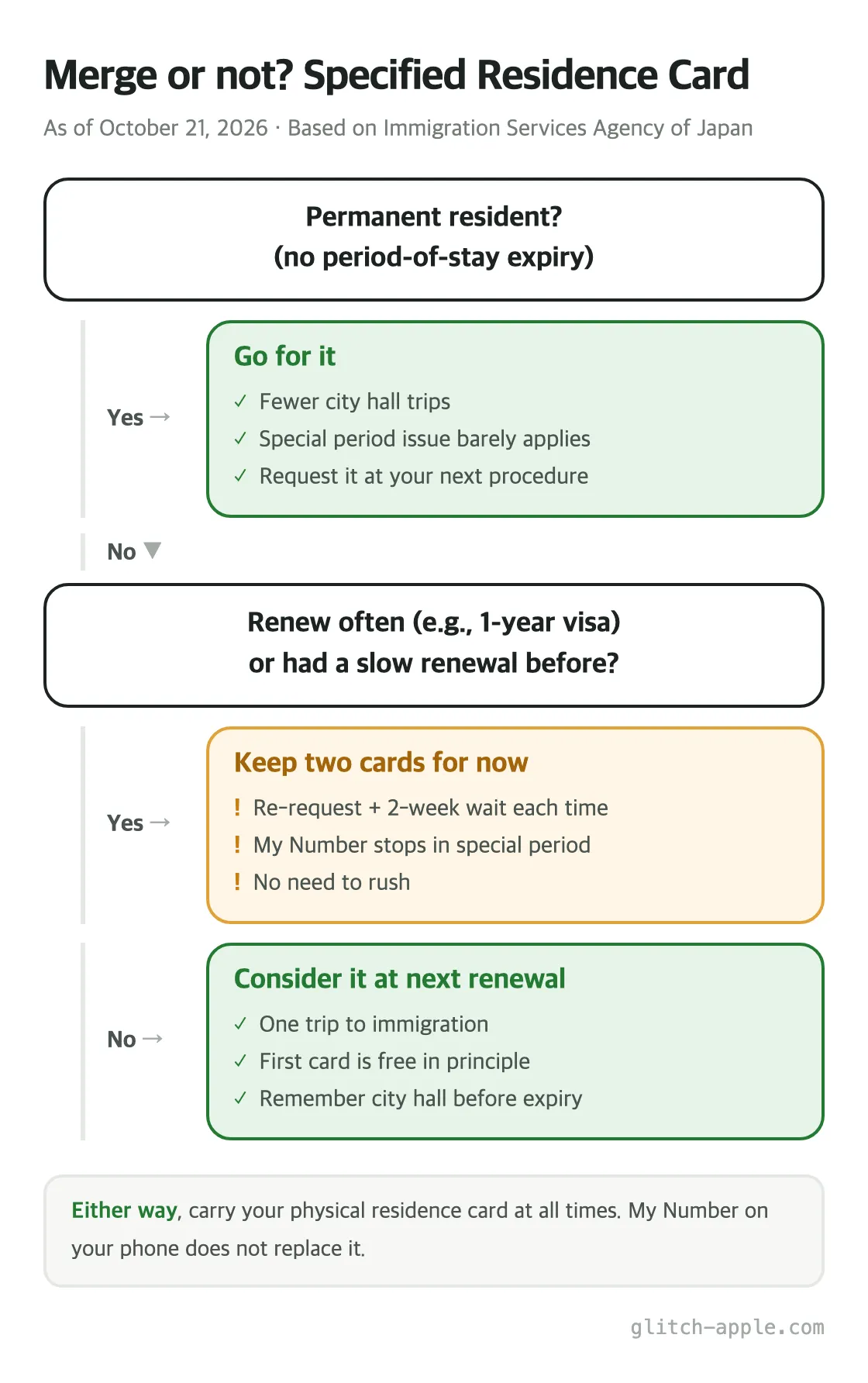
| Switching makes sense if you… | Better to wait if you… |
|---|---|
| Are a permanent resident. No period-of-stay expiry, so downside 1 barely applies | Renew often (e.g., 1-year visas). You’d hit downsides 1, 3 and 4 every time |
| Move a lot and hate visiting both immigration and city hall | Have had a renewal take a long time before (risk of the special period) |
| Keep forgetting your My Number Card | Use My Number health insurance often (the gaps in 1 and 2 hit you directly) |
| Plan to leave Japan or change jobs soon |
In short: the longer and more stable your stay, the more you gain. The more often you renew, the more hassle it adds. There’s no rush. You can request it at your next renewal.
Fees
There are two separate fees.
| Paid to | Amount |
|---|---|
| Immigration Services Agency (residence card part) | ¥1,900 (revenue stamp) |
| J-LIS (My Number Card part) | ¥600, or ¥800 with an electronic certificate |
However, your first Specified Residence Card issued on or after June 14, 2026 is free in principle. Later reissues, such as a voluntary exchange, may require fees.
How to apply
You don’t file a separate application. You add it on to a procedure you’re already doing.
| When | Where |
|---|---|
| Visa renewal or change, permanent residency application, residence card reissue, etc. | Regional Immigration Services Bureau |
| Moving-in notification or other address notification | City / ward office |
What to bring (at an immigration bureau)
- Specified Residence Card application form
- PIN setting request form (if someone applies for you, seal it in an envelope)
- One photo (taken within 6 months, no hat, facing front, plain background)
- Passport and current residence card
- Documents for the procedure you’re filing at the same time (renewal, etc.)
Applicants 16 and older generally need to apply in person. The card is not issued at the airport on arrival.
What about the “Android My Number Card” that launched in October?
These are easy to mix up, but they’re separate systems.
Since October 20, 2026, you can add your My Number Card to an Android phone (Google Wallet) (iPhone got it earlier). You can then log in to Myna Portal, use My Number health insurance, and get certificates at convenience stores with just your phone.
| What your phone can do | Standard | Limited |
|---|---|---|
| Myna Portal login | ✓ | ✓ |
| My Number health insurance at clinics and pharmacies | ✓ | ✓ |
| Certificates at convenience stores | ✓ | ✓ |
| In-person ID check (showing photo, name, age) | ✓ | ✗ |
- Only supported models running Android 12 or later with the latest security patch. Depending on the model, you get a “Limited” (機能限定) version with fewer features
- You need a physical My Number Card first to add it to your phone
- The Digital Agency itself says to always carry the physical card in case the phone version can’t be used

What matters for foreign residents: a My Number Card on your phone does not replace your residence card. By law, you must carry your residence card (including a Specified Residence Card) at all times, phone or no phone.
Also, whether a Specified Residence Card can be added to a phone isn’t mentioned in the Digital Agency’s guides or FAQ (as of October 21, 2026). The Digital Agency’s “My Number Card In-Person Verification App,” which businesses use to read cards, has supported Specified Residence Cards on iOS since June, but the Android version only says support is “planned.” I’ll update this post when that’s confirmed.
FAQ
Do I have to switch?
No. It’s optional, and your current residence card stays valid until it expires.
Does the front of the residence card change?
Yes. For residence cards issued on or after June 14, 2026 (Specified or regular), the period of stay (e.g., “3 years”), permission type, permission date, and issue date are removed from the front and stored only on the IC chip. The expiry date stays on the front. Children from 1 to under 16 now get a photo too.
What if I lose it?
Report it to the police, then apply for a residence card reissue at immigration first. You can request a Specified Residence Card afterwards as an exchange.
Can I go back to a regular card?
Yes. Just don’t request it at your next renewal, or apply for a reissue at immigration if you want to switch now.
Summary
- Specified Residence Card = residence card + My Number Card. Optional, no rush
- Great if your stay is stable (e.g., permanent residents); more hassle if you renew often
- In the special period the My Number functions stop, so extend them at city hall before your original expiry date
- First issuance is free in principle, takes 2+ weeks, counter only
- Even with My Number on your phone, you still have to carry your physical residence card
Sources
This post is based on the official sources below (checked October 21, 2026).
- Immigration Services Agency: Specified Residence Card application (Japanese)
- Immigration Services Agency: Q&A on merging the residence card and My Number Card (Japanese)
- Digital Agency: My Number Card on Android (Japanese)
- Digital Agency: In-Person Verification App now supports Specified Residence Cards on iOS (Japanese)
- Myna App Support: Supported Android models (Japanese)
Comments